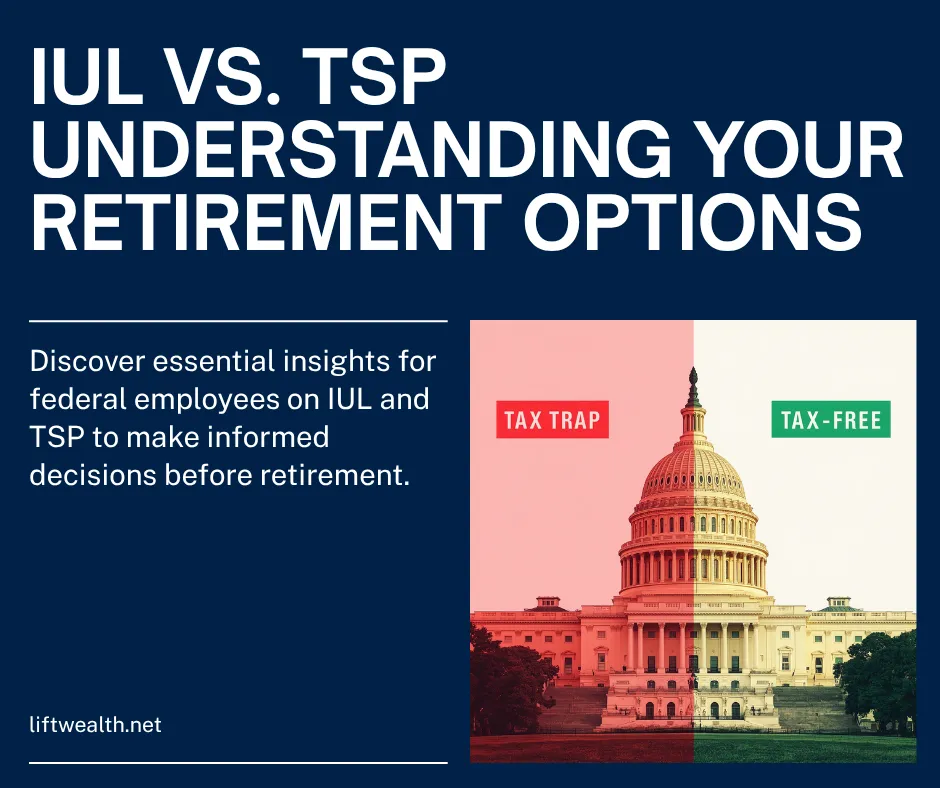
IUL vs. TSP: What Federal Employees Need to Know Before They Retire
I spent 33 years as an FAA Air Traffic Controller. During that entire career, I did exactly what the federal government told me to do with my money: I maxed my TSP, stayed invested, and watched the balance grow.
When I retired in 2020, I had built up a substantial TSP account. And then I learned the truth about what I had actually built.
Not a tax-free retirement account. A deferred tax account. One where the IRS gets a vote on every dollar I pull out, at whatever tax rate Congress decides is appropriate at the time.
That discovery changed everything for me. This post is what I wish someone had explained to me 20 years earlier.
What Is the TSP?
The Thrift Savings Plan is the federal government's version of a 401(k). If you work for a federal agency (whether the FAA, the military, the VA, the post office, or anywhere else), the TSP is your primary retirement savings vehicle outside of your pension.
Most federal employees contribute pre-tax dollars to the TSP. The money grows tax-deferred, meaning you pay no taxes on it while it sits in the account. The TSP offers several investment funds (G Fund, C Fund, S Fund, and others) and has some of the lowest expense ratios in the retirement savings industry.
On the surface, it looks like an excellent deal. And for accumulating a large balance, it is.
The problem shows up at retirement.
The Tax Trap Nobody Explains
When you retire and start pulling money out of your TSP, every dollar you withdraw gets taxed as ordinary income. Not capital gains rates. Ordinary income rates, the same rates that apply to your paycheck.
Here is why that matters:
Required Minimum Distributions (RMDs). Starting at age 73, the IRS requires you to take money out of your TSP whether you want to or not. The amount is calculated based on your account balance and your life expectancy. In years when you do not need the money, you still have to take it, and pay taxes on it.
Tax rate risk. Your TSP withdrawals will be taxed at whatever federal income tax rates exist when you pull the money. The One Big Beautiful Bill Act (OBBBA), signed July 4, 2025, made the TCJA income tax rates permanent. That is good news in the short term. But "permanent" does not mean forever. Congress has changed tax rates dozens of times in the past century, and future lawmakers can raise them again. When your tax bill in retirement depends entirely on what Congress decides, that is not a plan. That is a risk you have no control over.
State income taxes. Depending on where you live in retirement, your state may also tax TSP withdrawals. Florida does not have a state income tax, which is one reason I chose to retire here. But if you move to a state that does tax retirement income, your TSP withdrawals get hit twice.
The Social Security interaction. If your TSP withdrawals push your total income above certain thresholds, up to 85% of your Social Security benefits become taxable. The OBBBA added a temporary $6,000 senior bonus deduction for taxpayers age 65 and older, available through 2028. That helps lower-income retirees. But if your RMDs alone are pushing your Modified Adjusted Gross Income above $75,000 as a single filer (or $150,000 for married couples), you lose most or all of that deduction. And you still owe ordinary income tax on every TSP dollar you pull out. A large required withdrawal in any given year can trigger taxes on income you thought was coming to you free and clear.
The bottom line: you spent your entire career saving money that you have never actually paid taxes on. At retirement, that tax bill comes due, and you have very little control over when, how much, or at what rate.
What Is IUL?
An Indexed Universal Life (IUL) policy is a permanent life insurance contract with a cash value component. Your premium payments build cash value inside the policy, which grows based on the performance of a market index (typically the S&P 500) up to a cap.
The two features that make IUL powerful for retirement planning:
A 0% floor. In years when the index goes negative, your cash value does not go negative with it. You are credited 0% instead of losing money. In years when the market drops 30%, your policy loses nothing.
Tax-free access. The cash value inside an IUL policy grows tax-deferred, similar to the TSP. But unlike the TSP, you can access that cash value through policy loans that are income-tax-free. You do not pay taxes on the money when you take it out, and there are no RMDs forcing you to take money you do not need.
The death benefit adds another layer: the money left in your policy at death passes to your beneficiaries income-tax-free.
IUL vs. TSP: Side by Side
TSPIULContributionsPre-tax (traditional) or post-tax (Roth)After-tax premiumsGrowthMarket-based, tax-deferredIndex-linked with 0% floor, tax-deferredMarket loss protectionNoneYes, 0% floor in down yearsWithdrawalsTaxed as ordinary income (traditional)Tax-free via policy loansRequired Minimum DistributionsYes, starting at age 73NoDeath benefitAccount balance onlyTax-free death benefit to heirsContribution limits$24,500/year (2026); $32,500 if 50+; $35,750 if ages 60-63No IRS contribution limitAccess before 59½10% penalty + taxesNo penalty via policy loans
The TSP wins on simplicity, low fees, and the government match (if your agency offers one). For pure accumulation during your working years, the TSP is hard to beat.
The IUL wins on tax treatment at distribution, market protection, flexibility, and legacy. For retirement income you can actually control, IUL solves problems the TSP creates.
What the One Big Beautiful Bill Changed (and Did Not Change) for TSP Holders
The OBBBA generated a lot of headlines. Here is what actually matters for federal employees with a TSP:
What changed: The TCJA income tax rates are now permanent instead of expiring. TSP contribution limits were not touched. The federal pension structure (FERS High-3, the FERS supplement) remained intact. A new $6,000 senior bonus deduction is available through 2028 for qualifying retirees age 65 and older.
What did not change: RMDs still start at age 73. TSP withdrawals are still taxed as ordinary income. The Social Security taxation thresholds were not moved. The fundamental tax problem with a traditional TSP in retirement is exactly what it was before the bill passed.
The rate permanence is useful if you are doing Roth conversions or tax planning right now. It gives you a known number to work with. But it does not fix the core issue: every dollar sitting in your traditional TSP is a dollar you will eventually pay ordinary income tax on at whatever rate applies when you pull it out. That rate is lower today than it has been historically. Whether it stays that way for the next 20 to 30 years of your retirement is a bet the bill does not let you off the hook from making.
What I Did With My Own TSP
After 33 years with the FAA, I had built a substantial TSP balance. When I retired in 2020, I made the decision to roll my TSP out and move that money into a strategy built around IUL policies.
I was not doing this on a theory or a whiteboard projection. I had studied the numbers, worked with professionals I trusted, and understood exactly what I was doing and why.
Today I personally own multiple IUL policies that I fund every month. I also own an annuity for guaranteed income and a portfolio of investment properties. The combination gives me income I can access tax-free, income that is guaranteed regardless of market conditions, and assets that will pass to my children without going through probate or getting hit with income taxes.
The entire retirement income strategy I teach at LIFT Wealth Strategies is the one I actually built for myself. That is not a marketing line. It is the reason I can explain every piece of it in plain English, because I lived through the decisions.
Who Should Consider Moving Money Out of the TSP
This is not the right move for everyone. But it is worth a serious conversation if you match any of these situations:
You are within 5 to 10 years of retirement. The closer you are to retirement, the more important tax treatment at distribution becomes. The accumulation phase is almost over. Now you need to think about how you actually pull the money out.
You expect to be in a higher tax bracket in retirement. If your pension plus Social Security plus TSP withdrawals will push you into a high bracket, finding sources of tax-free income becomes critical.
You want to leave money to your children or grandchildren. TSP assets are fully taxable to heirs. IUL death benefits pass income-tax-free. If legacy matters to you, the tax treatment at death is a significant difference.
You have more saved than you will spend. If you have more in your TSP than you realistically need for retirement income, some of that excess is just sitting there accumulating a future tax bill. Moving it into a different vehicle can change the outcome for your heirs significantly.
You want control over your retirement income. The TSP puts the IRS in control of when and how much you take out. IUL puts you in control.
Common Objections
"IUL has fees and the TSP doesn't."
The TSP has some of the lowest expense ratios available. That is true. IUL policies have insurance costs and administrative fees built in. The relevant question is not which product has lower fees in isolation. The relevant question is which strategy produces better after-tax income over your retirement lifetime. A product with higher fees that produces tax-free income can easily outperform a low-fee product that produces fully taxable income, depending on your tax situation and time horizon.
"I already have a Roth TSP."
The Roth TSP is an improvement over the traditional TSP for tax treatment. Your withdrawals are tax-free in retirement if you follow the rules. However, Roth TSP accounts are still subject to RMDs during your lifetime (though the rules changed slightly with SECURE Act 2.0). And Roth TSP does not offer a death benefit, market loss protection, or the flexibility of policy loan access.
"I don't understand life insurance as an investment."
Neither did I, at first. That is exactly the myth I work to break down. IUL is not life insurance in the way most people think of it. The death benefit is part of the structure, but the strategy is built around the cash value: how it grows, how you access it, and how it interacts with your overall retirement income picture. I teach this in plain English because that is how I learned it myself.
The Bottom Line
The TSP is a powerful accumulation tool. If you are in the middle of your federal career and your agency matches contributions, you should absolutely take that match.
But accumulating a large TSP balance and having a tax-efficient retirement are two different things. The TSP gets you to the mountain. How you structure your income in retirement determines whether you actually keep what you built.
If you are a federal employee (or recently retired from federal service) and you have never had someone walk you through exactly how your TSP withdrawals will be taxed, what your RMD situation looks like, and what alternatives exist, that conversation is worth having.
That is exactly what I do in a free 30-minute strategy call.
Book a Free Strategy Call
No pitch. No pressure. Just a clear look at your retirement picture and what tax-free options might make sense for your situation.
Carl G. Bullard is a licensed life insurance agent (FL License #W838079), licensed in multiple states. He is an independent agent affiliated with Global Financial Impact (GFI). Life insurance products involve risk and are not guaranteed. Results vary based on individual circumstances. This content is for educational purposes only and does not constitute financial, tax, or legal advice. The information about TSP is general in nature. Consult a qualified financial or tax advisor regarding your specific situation.
